Organisational Models
Impact Focus
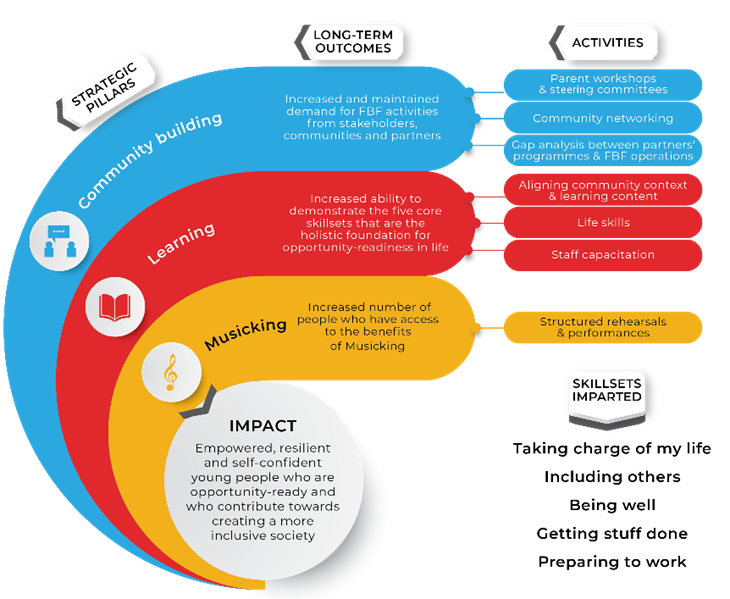
We have a clear and well-researched Theory of Change (ToC), which was revised in 2021 together with representatives of our young band staff for optimal ownership. This focuses on personal development and vocational skills’ acquisition, as well as community resilience and societal cohesion, and has three pillars.
Our first two areas focus on individuals using musicking and learning to effect behavioural change. This is where band members are learning about music and performance but also practicing the foundational skills needed for any kind of learning: focus, discipline, goal-setting etc. Our method of imparting knowledge and experience is the field band experience itself, through musicking, team-working and ‘taking-responsibility’ activities.
The third area community building and resilience .
We know and recognise that any individual intervention should aim for a systemic impact. The systems in which we operate are highly complex and are largely made up of community members and their structures, impact agencies such as ourselves, and large economic actors who are sometimes donors. Overlayed across these relationships are dynamics that are ever-changing and too often impacted by significant social and economic pressures. It is within this environment that we help our individual members learn how to take agency and become reliable and contributing “parts” of the systemic “whole”.
Theory of Change
Our ToC is the developmental model in which we situate our activities. It depicts the causal pathway between the capacity building of staff and band members and the goal of empowered and healthy young people able to contribute to a vibrant society.
FBF activities are designed to positively influence the knowledge, skills, attitudes and behaviours of staff to enrich their social and professional skillsets. This empowers them to create an environment that fosters a heightened commitment to self-development and improved emotional resilience for themselves and the band members. These empowered individuals are then able to contribute towards stimulating similar positive changes within their communities.
Three major assumptions inform our approach:
- Capacitating tutors will transfer pertinent skills, knowledge and behaviours to band members
- The band environment (consisting of the relevant change constructs for youth development detailed below) will provide protective factors to mitigate socio-economic risks and enable improved commitment to self-development and resilience
- Music education, life skills and the resulting enhancement of resilience and self-development competencies contribute to overall improved health and well-being
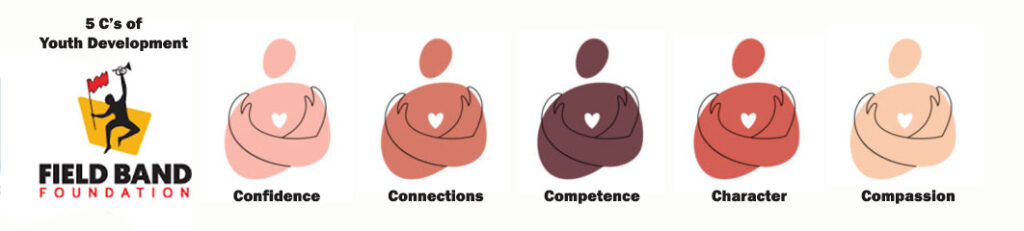
Constructs of Change
We have adopted our change constructs from the Positive Youth Development perspective. The origins of this perspective dates to the 1900’s, when scholars and practitioners in Child Psychology and Prevention sciences collectively advocated for and implemented a shift in the youth development approach.
This shift emphasised engagement with youth strengths and talents rather than a deficit-centred youth development FBF Model for Youth Development approach.
The band environment must be created in such a way as to foster fundamental change constructs and provide a safe space for people to practice and reinforce new/alternative learnt skills and beliefs.
The change constructs are therefore the bedrock concepts for FBF strategies, M&E planning as well as tool development.